Protecting Shoulder Health in Wheelchair Users: The Role of Exercise and Movement
Exercise programmes should focus on protecting shoulder integrity rather than simply building strength. The aim is to improve the strength, endurance and coordination of the shoulder girdle and trunk, reducing excessive loading during propulsion, transfers and other daily activities.
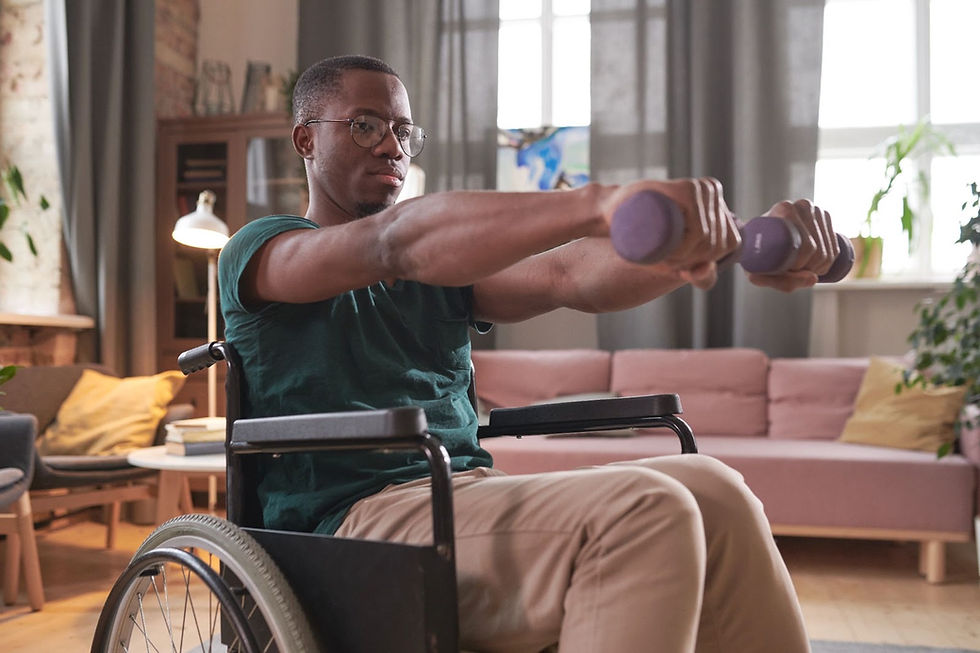
Recommended exercises should target:
● Core stability muscles – including the transversus abdominis, multifidus, internal and external obliques, rectus abdominis, erector spinae and quadratus lumborum. These muscles provide trunk stability, creating a stable base for efficient upper limb movement and reducing compensatory shoulder loading.
● Rotator cuff strengthening – focusing on the supraspinatus, infraspinatus, teres minor and subscapularis to improve dynamic glenohumeral stability and reduce the risk of impingement and rotator cuff injury.
● Scapular stabilisation – strengthening the serratus anterior, lower trapezius, middle trapezius and rhomboids, while promoting balanced activation of the upper trapezius. These muscles optimise scapular positioning and improve shoulder mechanics during propulsion and transfers.
● Posterior shoulder strengthening – targeting the posterior deltoid, latissimus dorsi and teres major, which help counteract the rounded shoulder posture frequently seen in wheelchair users and improve shoulder extension and stability.
● Stretching and mobility exercises – focusing on the pectoralis major, pectoralis minor, anterior deltoid, latissimus dorsi and posterior shoulder capsule to maintain flexibility, improve scapular movement and reduce the risk of subacromial impingement.
● Functional movement training – practising efficient wheelchair propulsion, transfers, reaching and pressure-relieving techniques to minimise repetitive loading and improve movement economy.
● Aerobic conditioning – activities such as functional electrical stimulation-assisted rowing, arm ergometry or adapted cardiovascular exercise, where appropriate, to improve endurance while maintaining shoulder health.
Exercise should always be individualised following a comprehensive postural and functional assessment. Programmes should consider the individual’s posture, trunk control, shoulder biomechanics, wheelchair configuration and daily functional demands. When combined with optimal seating and positioning, targeted exercise can help preserve shoulder integrity, reduce pain and support long-term independence.

Comments